New Series: Let’s Build a Simple Database…in Rust
Hey, all! Back at it again trying to write posts. While I do believe the Roundup posts are great and will hopefully force me to stop coding and write about what I’m doing, I wanted to come up with a solid series of developing something from scratch. I’ve been intrigued by databases and their internals for awhile now and one of the more fascinating posts that I have read about database internals is from cstack on Github. That tutorial walks you through making a minimal sqlite clone in C. I have written a fair bit of C in my time (refer back to the about page on offensive security tools, they are predominantly in C) and even started working through the code but I eventually plateaued and stopped working through it. I thought a way to motivate me to get through it and really learn was to write that clone in Rust with all of the challenges of the borrow checker, ownership, and the like.
The plan is to try to follow the tutorial’s fifteen parts as closely as possible, but in Rust. I’m also going to attempt to avoid dependencies at all costs for two reasons:
- SQLite itself prides itself on minimal dependencies. I’ve heard on a podcast with the creator that with no dependencies comes freedom to do what you want; it’s like backpacking in the wilderness, you’re all on your own.
- Using something like the
BTreeMapin the Rust standard library feels like cheating. We have to struggle through this!
Edit: I have also decided to incorporate Phil Eaton’s blog post on writing a SQL database in Zig with RocksDB as the storage layer. You can find the blog post here. This series is going to be a slight marrying up of cstack’s tutorial and Phil’s. Why? Well, in cstack’s tutorial, the focus is on the storage layer using a B-tree but as a result, the lexing and parsing of SQL syntax is sort of handwaved. Even in part 2 of cstack’s tutorial, the SQL syntax isn’t exactly the same as you would find in SQLite. It’s a more custom syntax. On the other hand, Phil’s blog dives deep into lexing and parsing of SQL syntax but slightly handwaves the storage layer (I say that in the sense that the actual on-disk representation of the database is handled by RocksDB, but Phil still has to represent the tables and rows in the key-value store which did take effort to get right). As a result, I feel that combining the frontend portion of Phil’s post with the backend portion of cstack would be a nice way to expose a closer-to-reality SQLite clone.
Extensions
I plan to make a few extensions to the original at the end (if I’m up for it). One of them would be to add the Write Ahead Log (WAL) functionality of SQLite. This functionality is a key component of allowing SQLite to be distributed (many distributed SQLite extensions and components leverage the WAL). With that, I may be able to tie together my Raft implementation with this small sqlite clone.
I’m going to try to do my best and make it close to SQLite. I know I won’t get there but the tutorial seems to focus in on the key components of SQLite and I may want to add some of the other features.
Other extensions are in my mind as well (maybe some python bindings to allow the use of this clone within python) and will be explored as we make our way through.
Table of Contents
Here is the table of contents for the entire series. I wanted this to be higher in the post. See below this section for Getting Started!
These are going to take the form of the original series by cstack mostly. More will be added as we work our way through.
Getting Started
To get started, I’m going to create a new Rust crate. I’ll start by creating
this as a library with a binary for a command line tool (like the sqlite3
binary you can use to view SQLite databases from the command line). The purpose
for this is extensibility with potential future extensions. It makes it a lot
easier to start with a library and port that than try to undo a binary.
We’re calling this FoundryDB (foundry -> Rust get it?):
cargo new foundrydb --lib
# get the simple binary file created
touch src/main.rs
Then, update Cargo.toml to look like this:
[package]
name = "foundrydb"
version = "0.1.0"
edition = "2024"

[lib]
name = "foundrydb"
path = "src/lib.rs"

[[bin]]
name = "fdb"
path = "src/main.rs"

[dependencies]
I’ll leave the default lib.rs code of add and add some scaffolding to
src/main.rs to make sure they’re playing nice.
In src/main.rs:
use foundrydb::add;

fn main() {
    println!("Inside fdb! {}", add(1, 2));
}
Then, we can verify we can test and run the library and binary respectively:
cargo test
cargo run
Of course, we now push to Github. You can find the repo here. We’ll add a README later on.
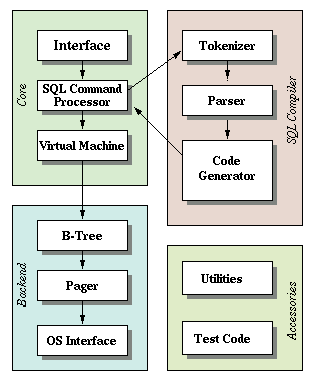
In the spirit of cstack’s original post, I’ll include the SQLite Architecture diagram as referenced at https://www.sqlite.org/arch.html.